Ningbo Force Auto Parts Co., Ltd.
- joe@forcerigging.com
- +86-18650363763
Ningbo Force Auto Parts Co., Ltd.
A 45,000-pound steel coil does not look dangerous when it first rolls onto the flatbed. Then the truck takes a curve, the load settles a fraction, and a chain that seemed tight an hour ago develops slack. Coil loads are the heaviest, densest and least forgiving cargo most flatbed drivers will ever carry, and the difference between a safe trip and a claim is measured in working load limits and chain angles.
Here is the short version before the details. A coil loaded eye-to-the-sky needs at least four chains, each rated to at least one-eighth of the coil's total weight. A coil loaded eye-crosswise needs chocks plus chains routed through or around the eye. Every chain contact on the coil's sharp edge needs protection, and the whole setup has to be re-tensioned after the first ten or twenty miles. The sections below explain why these rules exist and how to apply them on a real load.
Content
A steel coil is not just heavy; it concentrates that weight into a form that is designed to roll. Coils travel in two orientations: standing on their round edge with the eye (the center hole) pointing up, or lying on their flat face with the eye pointing to the side. Both create separate problems for the load securement system.
Because of these four properties, coil securement is governed by dedicated rules rather than generic tie-down advice.
Before choosing straps or chains, you need to know the coil's orientation. The position of the eye defines the whole securement plan. In the United States, FMCSA 393.128 sets the minimum requirements for coil steel, and most other markets follow a similar logic.
The coil stands on its round edge with the hole pointing up. The rule requires at least four tie-downs attached directly to the coil, and each tie-down must have a working load limit of at least one-eighth of the coil's total weight. Adding chocks, dunnage or friction mats does not reduce that requirement; it improves the margin, but it does not replace the chains.
The coil lies on its flat face with the eye pointing sideways. FMCSA 393.128 requires the coil to be blocked or chocked against the deck, and the chains must pass through the eye and cross each other so the coil cannot shift or roll. For larger or heavier coils, an additional chain must also be secured over the top of the coil.
Most carriers and shippers treat the eye-to-sky position as the standard because it makes the four-chain layout predictable. For fleets that run mixed loads, the same logic extends to every cargo: identify the contact points, know the minimum WLL, and protect sharp edges. Professional crews apply these principles across trucking and transportation operations, and the same weighting discipline carries into other freight types.
The phrase "one-eighth of the coil weight" is the most important number in coil securement. It means each tie-down must be able to hold one-eighth of the total coil weight without failing. For an 80,000-pound coil, every chain must have a WLL of at least 10,000 pounds. Four chains at that rating give a combined margin of 40,000 pounds, exactly half the coil's weight, which is the safety margin the standard assumes.
| Coil weight (lbs) | Min. WLL per chain (1/8 of coil) | Combined capacity of 4 chains |
|---|---|---|
| 20,000 | 2,500 | 10,000 |
| 40,000 | 5,000 | 20,000 |
| 60,000 | 7,500 | 30,000 |
| 80,000 | 10,000 | 40,000 |
The practical lesson: never select chains by sheer size alone. Check the printed WLL on each chain. A 3/8-inch G70 transport chain with a 6,600-pound WLL is enough for a 40,000-pound coil, but it is not enough for an 80,000-pound coil. Step up to a 1/2-inch G70 chain at 11,250-pound WLL, or use more chains with a layout approved by your carrier or the shipper's load engineering team.
Chains are the default for good reasons. Their WLL is predictable, they do not stretch under load, and they resist the cutting action of the coil edge far better than webbing. Ratchet straps weigh less and tension faster, but a common 2-inch strap has a WLL of about 3,333 pounds, which is too low for most coils. Even a 4-inch strap, while stronger, remains vulnerable to the sharp lip of the coil.
The rule of thumb is simple: if a strap is allowed at all, it is an addition, not a replacement for the required chains. Its WLL must still meet the one-eighth requirement for its share of the load, and it must be protected where it touches the coil.
Tensioning is the part that most often gets skipped. A ratchet binder provides a consistent, controlled pull that you can re-tighten without a hammer. Unlike a lever binder, it does not rely on a sudden motion that can be dangerous when the chain is under heavy load.
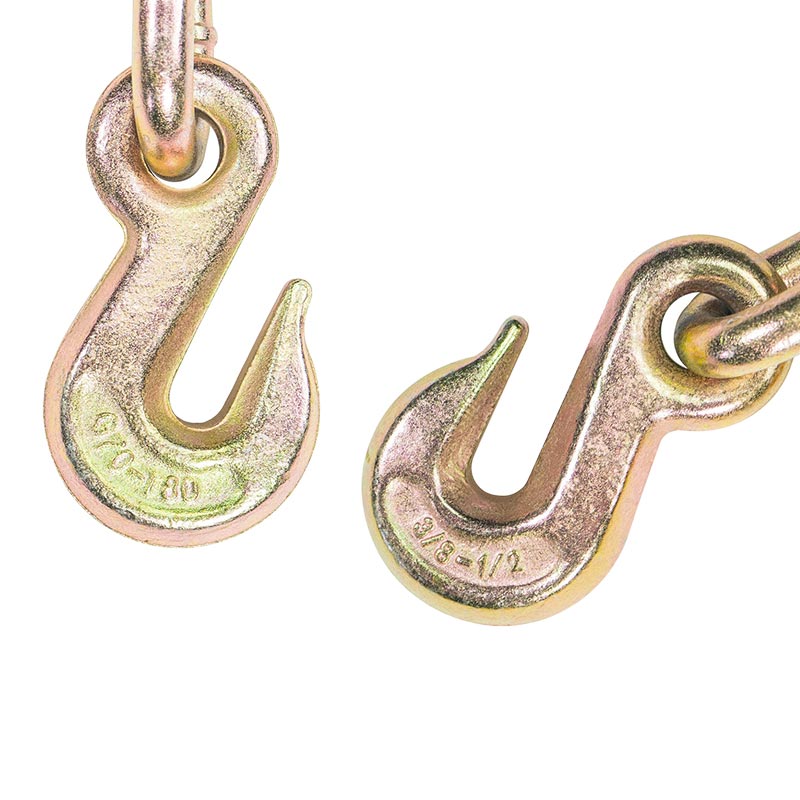 3/8" - 1/2" Ratchet Chain Binder with Forged Steel HooksThis industrial-grade ratchet binder fits 3/8" Grade 70 and 1/2" Grade 43 chains, offering incremental tightening for precise control. Its swiveling forged hooks simplify securement of heavy coils.View Product →
Most coil securement failures do not start at the chain hook. They start at the contact point. The coil's sharp lip concentrates the chain tension on a narrow line of contact. As the truck flexes and the load settles, the chain can bite into the steel edge, lose tension, or work loose from the eye.
A load edge protector fixes that. For chain work, a galvanized steel protector with a groove holds the chain on the radius of the coil and prevents it from cutting into the steel. Chocks and V-boards do the same job on the deck side, stopping an eye-crosswise coil from rolling while the chains through the eye are tensioned.
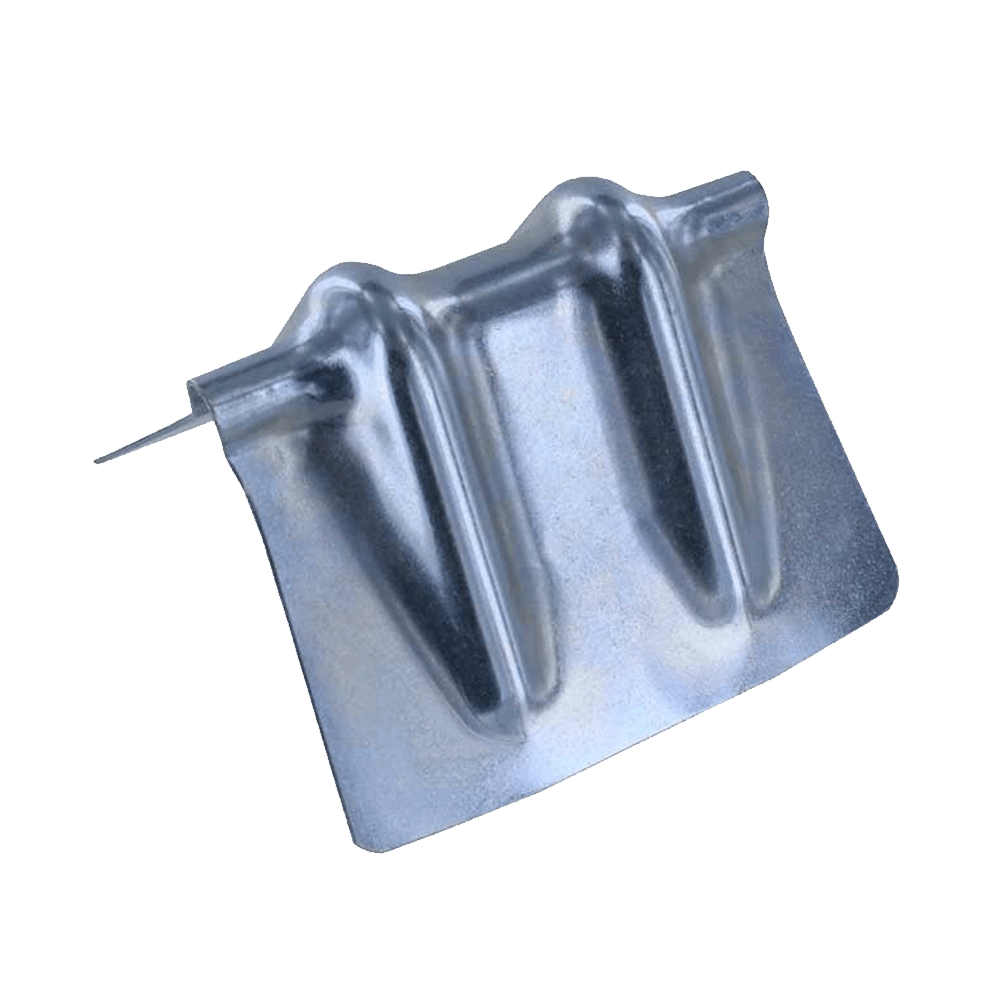 Galvanized Slotted Steel Corner Protector for ChainsA heavy-duty galvanized steel corner protector with dedicated side grooves locks chains in place and distributes pressure, preventing chain slippage and edge damage on steel coils during transport.View Product →
The importance of cargo edge protectors is often underestimated by new flatbed crews, but professional loaders treat them as part of the working load path, not as optional padding.
The securement job is not finished when the last chain is pulled. Steel coils are transported under tarps for a reason: rain, road spray and dirt will start rust on a coil in hours, and a receiver will reject a rusty coil even if the transport was safe. A heavy-duty coil tarp with reinforced edges and rust-resistant grommets is the standard choice for steel loads.
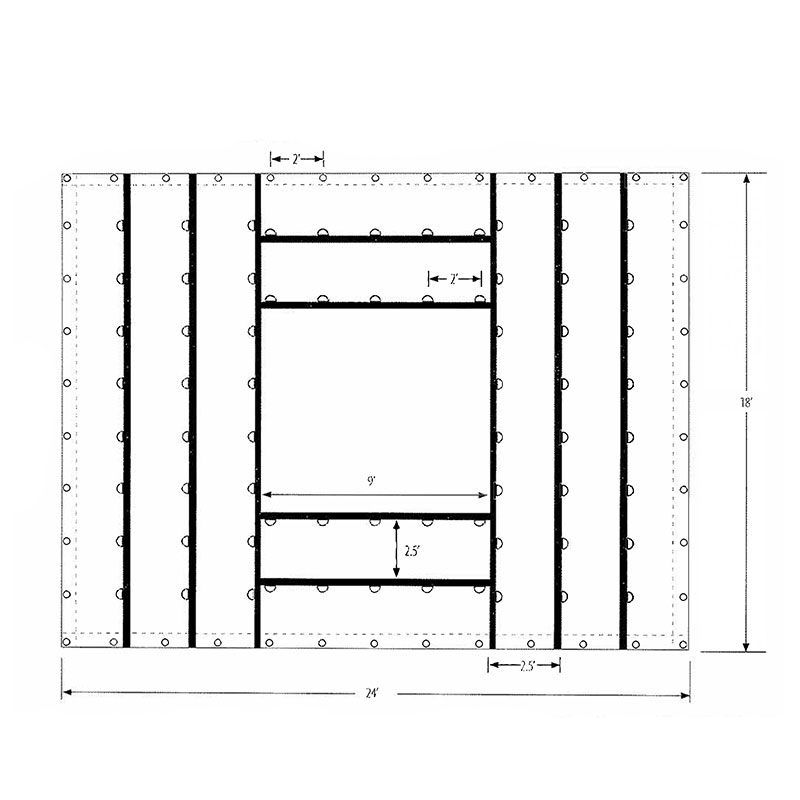 Black Heavy-Duty Coil Tarp with Waterproof CoatingMade of thickened polyethylene or polyester with waterproof, UV-resistant, and tear-resistant properties, this tarp protects steel coils from rain, road spray, and dirt, ensuring coils arrive dry and rust-free.View Product →
Tarp placement matters. The tarp should be pulled tight and lashed on both sides, but it should not be tucked so tightly against the coil that it traps moisture. A slight air gap lets the tarp breathe and keeps condensation off the steel. After tarping, always do a final walk-around with the chain binders still visible so the driver can re-check tension during the first stop.
Over years of inspecting flatbed loads, the same mistakes come up again and again.
After the first ten to twenty miles, stop and re-tension every chain. The coil settles, the deck flexes, and the chain links seat into place. That one stop often makes the difference between arriving with the load exactly where it started and arriving with a shifted coil that needs a crane.
Q1: How do you secure a steel coil on a flatbed?
The standard method uses four chains for an eye-to-the-sky coil, each rated to at least one-eighth of the coil's weight. Eye-crosswise coils need chocks plus chains routed through the eye. Edge protectors and re-tensioning after the first miles are required for a reliable job.
Q2: How many chains are needed for a coil on a flatbed?
FMCSA 393.128 requires at least four tie-downs for an eye-to-the-sky coil. Each chain must have a WLL of at least one-eighth of the coil's total weight, so four chains give a combined 50% margin.
Q3: What is a coil rack for flatbed trailers?
A coil rack is a steel cradle or frame that supports the coil and gives the chains or straps a defined anchor path. It is used when a coil cannot be chained directly or when the shipper requires additional protection, and it can reduce the load placed on the coil's edges.
Q4: Can ratchet straps secure a steel coil instead of chains?
Only if the carrier and regulations allow it and the strap's WLL meets the one-eighth rule. Straps are more vulnerable to cutting by the coil edge, so rated edge protectors are mandatory. For heavy coils, chains remain the recommended option.
Q5: Why do coils need a tarp on flatbed transport?
Rain, road salt and dirt cause rust and surface damage on exposed steel. A heavy-duty coil tarp keeps the cargo dry and clean, reduces receiver claims, and also protects the chains and binders from water corrosion.
Q6: Do I need edge protectors when chaining a coil?
Yes. The coil lip is sharp enough to cut chain links and webbing. A steel chain guard or heavy-duty plastic protector distributes the tension over the coil radius and prevents the chain from working loose.


The company specialises in the field of logistics transportation,cargo control,lifting and hoisting products.


joe@forcerigging.com
+86-18650363763
No.469, Liansheng Road, Yinzhou District, Ningbo, Zhejiang Province, China.315111
Copyright © 2025 by Ningbo Force Auto Parts Co., Ltd. All Rights Reserved. China Ratchet Straps Manufacturers OEM/ODM Load Binding and Rigging Company


 English
 Español
 عربى
عربى 中文简体
中文简体