Ningbo Force Auto Parts Co., Ltd.
- joe@forcerigging.com
- +86-18650363763
Most first container orders of wholesale ratchet straps go wrong for a boring reason: the buyer compared length and unit price, but never locked down the label. Six weeks later the pallets arrive with 2-inch straps rated in a way the destination market will not accept, hooks that do not fit the trailer anchor points, and a webbing colour nobody approved. Sorting that out usually costs more than the freight.
Ratchet straps are rated safety equipment, not a commodity accessory. In the United States, 49 CFR 393.106 requires the aggregate working load limit of the securement system to be at least half the weight of the cargo, so the figure printed on the tag carries legal weight. In Europe, EN 12195-2 defines what has to appear on that tag. Either way, the specification conversation starts before the quotation request. These seven factors are the ones that decide whether a bulk order ships clean or comes back.
Content
The first question is never "what does a 2-inch strap cost". It is "what working load limit does this load require, and under which standard is that limit stated". Buyers who skip this step end up comparing prices between products that are not equivalent.
Two numbers travel with every strap and they are not interchangeable. Break strength is what the assembly can take before it fails. Working load limit, or lashing capacity in European terminology, is the rated figure you are allowed to plan around. Market labelling differs: US labels typically show a working load limit in pounds alongside a break strength, while EN 12195-2 tags declare lashing capacity (LC) in daN plus the standard tension force (STF) the handle delivers. Do not convert one into the other by assumption. Ask the supplier which figure appears on the label, which standard the label follows, and whether the rating is for the complete assembly or the webbing alone.
For flatbed and trailer work in North America, 2-inch assemblies rated at 10,000 lb break strength are the familiar volume product. That rating assumes the hooks, buckle and stitching are all part of the same tested assembly, which is exactly where cheap alternatives cut corners.
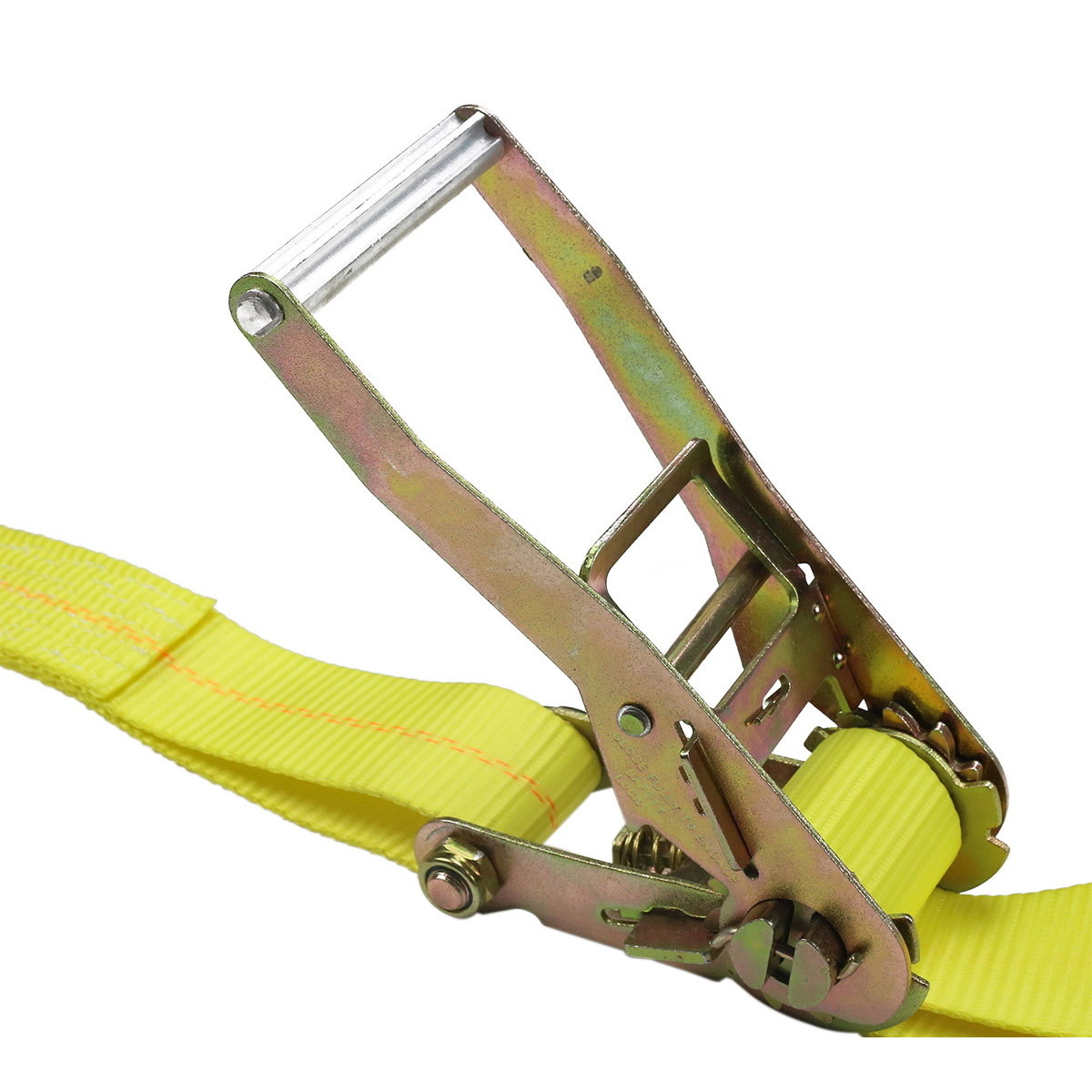 2-Inch 10,000 lb Polyester Ratchet Strap AssemblyHeavy-duty 2-inch polyester strap rated to 10,000 lb break strength for flatbed and trailer loads, with ratchet tensioning and 27 ft length.View Product →
Almost every cargo strap sold into regulated markets uses polyester, and that is not an accident. Polyester stretches little under load, so tension holds on a flat, rigid cargo; it resists moisture and does not support mildew; and it holds colour and strength under prolonged sun exposure. Nylon is the specialist choice, not the default. It stretches more, which absorbs shock and vibration on motorcycles, ATVs and boat trailers, but that same stretch lets tension creep on a static flatbed load.
Material name alone is not enough. Ask whether the yarn is high-tenacity polyester, what the webbing weight per metre is, whether the edges are woven with heavier edge yarns for abrasion resistance, and how colour is applied. Surface-dyed webbing looks identical on day one and fades unevenly in service.
| Behaviour | Polyester (PES) | Nylon (PA) |
|---|---|---|
| Stretch under tension | Low; holds tension on rigid loads | Higher; absorbs shock and vibration |
| Moisture and mildew | Resists absorption | Absorbs moisture, dries slowly |
| Outdoor UV exposure | Good long-term durability | Moderate |
| Typical bulk use | Flatbed, trailer, container, vehicle transport | Motorcycle, ATV, marine and sprung loads |
| Procurement note | Default for EN 12195-2 cargo straps | Specify deliberately; never substitute silently |
Width is a rough proxy for capacity and a direct input for hardware compatibility. One-inch and 25 mm straps suit light duties such as motorcycles, garden equipment and roof racks. Two-inch and 50 mm straps carry most flatbed and trailer cargo and account for the largest volume in wholesale programmes. Three-inch and four-inch straps exist for heavy plant, steel and oversized loads, and they need matching buckles and hooks.
Length is where bulk buyers lose money. Measure the actual strap route over or around the load, anchor point to anchor point, then add the free tail you need to grip and tension comfortably. A strap that is 300 mm short is scrap; a strap that is 2 m long leaves excess tail to flap and chafe. In practice, most distributors standardise on two or three lengths rather than a full ladder.
Regional habits matter here. One-inch by 15 ft and 2-inch by 27 ft or 30 ft are the workhorse sizes in North America, while metric lengths of 4 m, 6 m, 8 m and 10 m dominate European catalogues. If you are building an assortment, start from the lengths your customers already order rather than from what a factory happens to hold in stock. Our US-standard ratchet tie-down straps follow these familiar length and width conventions.
The ratchet buckle is the part your customer touches, and it is the first thing that signals quality. A stamped, thin-gauge buckle flexes under tension and the release lever binds; a properly formed 2-inch 5-tonne buckle opens with one hand even after a long run. Handle material is a practical decision: aluminium handles are light and resistant to rust, rubber and plastic coated handles are easier to grip in cold or wet conditions, and long wide handles generate more tension with less hand force. Ratchet buckles on European-style straps commonly come with a long handle for that reason.
Hooks and end fittings decide whether the strap fits the vehicle at all. Flat hooks drop into flatbed stake pockets and rub rails. Wire hooks clip into D-rings. J-hooks hook around pipe and tube. Swan hooks are the Australian convention and match local anchor hardware. Chain extensions reach anchor points that are too far or too awkward for webbing alone. Vinyl coating on hooks protects painted surfaces and slows corrosion, and a functioning safety latch should never be treated as optional.
 2-Inch 5T Steel Ratchet Buckle with Zinc FinishHeavy-duty zinc-plated ratchet buckle for 2-inch webbing, offering 5,000 kg breaking strength and reliable tensioning for truck, marine and industrial cargo lashing.View Product →
Surface finish is worth specifying too. Zinc plating, black electrophoresis and powder coating behave differently in coastal and road-salt environments, and mixed finishes across one order look like inconsistent supply even when the parts are functionally identical.
A ratchet strap without a compliant label is not legally usable in most regulated markets, no matter how strong it is. EN 12195-2 requires the tag to identify the manufacturer, year of manufacture, material, length, lashing capacity, standard tension force, elongation at lashing capacity, and the standard itself. The Chinese and US markets, and Australia and New Zealand under AS/NZS 4380, each carry their own labelling expectations. Colour is never a rating; it is a customer preference.
Before production, request a label proof and read it the way a roadside inspector would. Check that the LC figure matches the assembly you approved, that the length on the tag matches the length in the carton, and that the standard reference is the one the destination market actually applies. A label error discovered at the port is far more expensive than a label review done at the sample stage. For buyers supplying fleet operators, it also helps to understand how the end use shapes the order, which is why trucking and transportation programmes so often demand tighter label and packaging control than general retail.
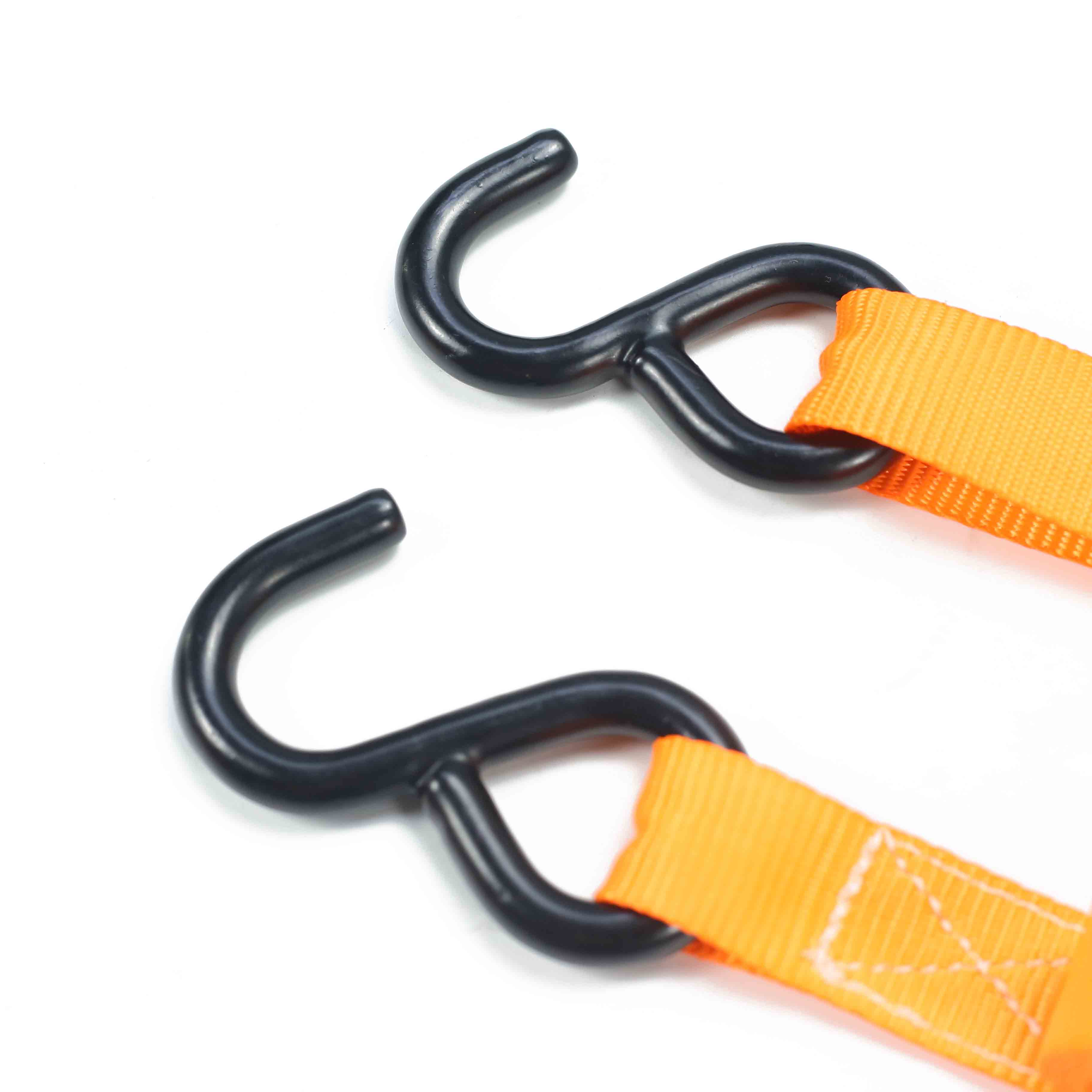 EN12195-2 Polyester Ratchet Tie-Down with S HooksEuropean-standard 15 ft cargo strap with polyester webbing and S hooks, suited to furniture, appliance and machinery loads where compliant labeling and secure anchoring matter.View Product →
Webbing rarely fails in the middle. It fails where it crosses a sharp corner, a stamped steel edge or a rough weld. Once a cut or abrasion mark reaches the load-bearing yarns, the assembly's capacity is compromised and cannot be restored. That is why experienced buyers treat corner protection as part of the securement system rather than an upsell.
Plastic V-boards and angle corner protectors are the low-cost default for brick, block, steel sections and machinery. Rubber protectors absorb vibration on machined and painted surfaces. Steel corner protectors with a groove are designed for chain, where abrasion is more aggressive. Protective sleeves on axle and wheel straps perform the same job for vehicle transport. In a wholesale order, specify the protector type and quantity per strap set so your customer receives a complete, usable kit rather than a strap that damages the cargo it secures.
Illustrative diagram of a ratchet tie-down assembly — not to scale.
The last factor decides whether the first six hold up over repeat orders. A trading company can quote a good sample; only a manufacturer can keep the twentieth container identical to the first. Ask where the webbing is woven, where the hardware is stamped or cast, and how the assembly is stitched. Box-X stitching at anchor points, consistent stitch density, clean thread trimming and matched hardware plating are all visible in a sample.
Testing is the other half. Ask for the pull-test procedure per production lot, the sampling basis, and a copy of the test record that ships with the goods. Confirm how the factory handles UV and colour-fastness expectations for outdoor markets, and whether rejected lots are quarantined. None of this should be improvised after the purchase order is signed.
On commercial terms, most factories set MOQ per SKU rather than per order, so a mixed container is the practical entry point. Custom logo printing on the ratchet handle, custom label artwork, custom lengths and retail-ready polybags or header cards all sit inside normal OEM and ODM workflows, but each one adds tooling, proofing or packing time to the lead time. Nail down these points in writing:
Three things: MOQ per SKU, batch consistency, and control over labelling and packaging. You are no longer buying a product off a shelf, you are approving a specification that has to repeat identically for the life of the programme.
Not reliably, and not across markets. Ratings are stated under different standards and design factors. Ask the supplier to confirm the rated working load limit or lashing capacity printed on the label, and check it against the securement rules of the destination country.
For flat, rigid cargo such as steel, timber, pallets and vehicles, polyester is the better default because it holds tension. Nylon earns its place on sprung loads like motorcycles and ATVs where shock absorption matters more than low stretch.
EN 12195-2 tags declare lashing capacity in daN, standard tension force and elongation at lashing capacity, plus the standard reference. US labels typically show a working load limit in pounds. The two systems are not freely interchangeable, so specify the destination market up front.
Both depend on the SKU mix, the webbing colour, whether new hardware tooling is needed and the label approval timeline. Quantities, tooling cost and production lead time are usually confirmed against a specific specification and order plan rather than quoted generically.
Inspect the sample for webbing weight, edge yarn integrity, stitch density at the anchor points, hardware gauge and plating uniformity, then request the pull-test record for the production lot. A visual check alone will not tell you whether the yarn is high-tenacity polyester.
If you are planning a bulk programme and want to compare specifications, our team can review your load profile, destination standard and packaging requirements, and come back with a matched quotation for samples or a trial order.

The company specialises in the field of logistics transportation,cargo control,lifting and hoisting products.


joe@forcerigging.com
+86-18650363763
No.469, Liansheng Road, Yinzhou District, Ningbo, Zhejiang Province, China.315111
Copyright © 2025 by Ningbo Force Auto Parts Co., Ltd. All Rights Reserved. China Ratchet Straps Manufacturers OEM/ODM Load Binding and Rigging Company


 English
 Español
 عربى
 中文简体