Ningbo Force Auto Parts Co., Ltd.
- joe@forcerigging.com
- +86-18650363763
Ningbo Force Auto Parts Co., Ltd.
E track straps and hooks are the core securing components of any cargo trailer tie-down system — they connect directly to the E track rail mounted on your trailer walls, floor, or ceiling, and allow you to anchor, restrain, and position loads of virtually any shape or size. Unlike fixed anchor points, an E track system for cargo trailer use gives you a fully configurable grid of attachment points that can be repositioned for every haul. Whether you are transporting motorcycles, pallets, furniture, or construction equipment, understanding how each component fits together determines whether your cargo arrives safely or shifts in transit.
Content
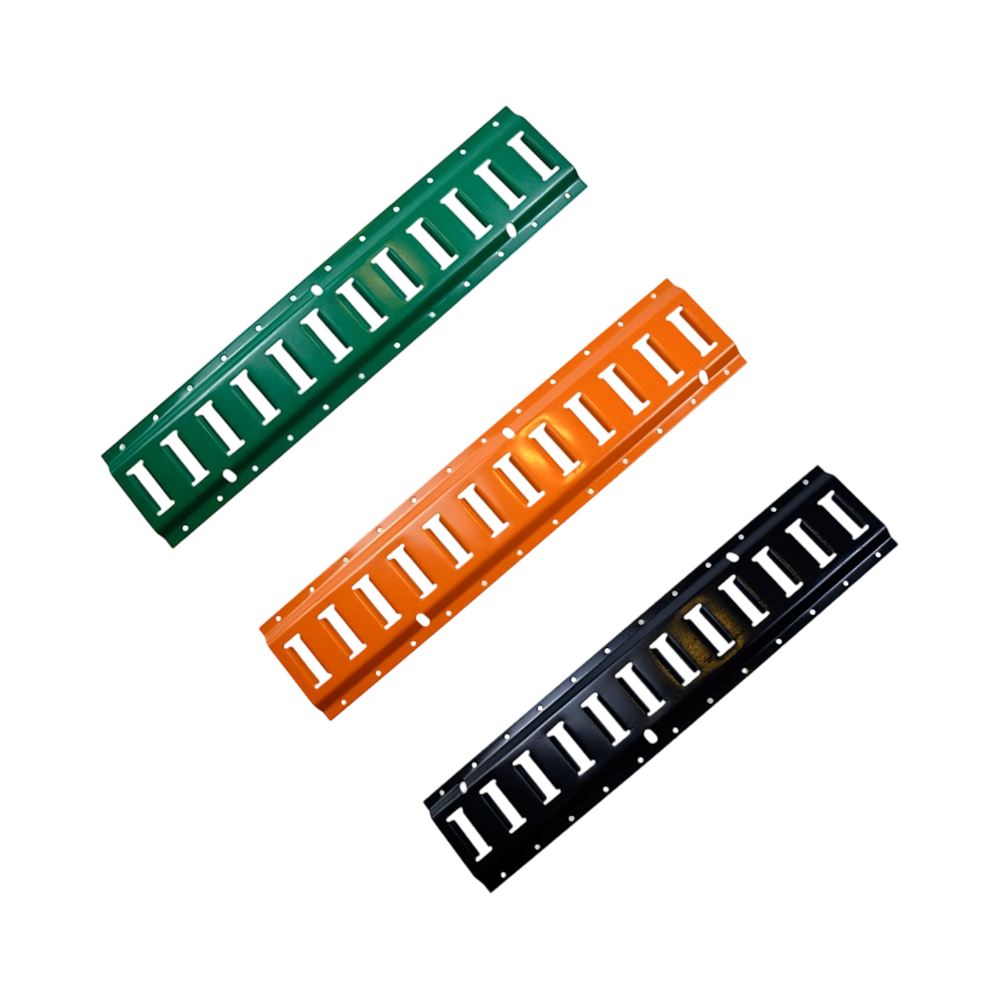
E track is a slotted steel rail — typically formed from 12-gauge or 10-gauge steel — with stamped openings spaced exactly 2 inches on center along its length. Each slot is shaped to accept a standardized fitting: a spring-loaded end fitting that slides in, rotates, and locks into place with a simple push-and-twist motion. The rail itself comes in standard lengths of 2 ft, 5 ft, 8 ft, and 10 ft, and can be joined end-to-end to span an entire trailer wall or floor.
The system operates on a three-component logic:
This modular design means every anchor point in your trailer can be moved in 2-inch increments to match the exact footprint of whatever load you are carrying — a capability that fixed D-rings or bolt-on anchors simply cannot match.
Not all fittings serve the same purpose. Choosing the right hook or fitting is as important as choosing the right strap. Here are the primary types used in a complete E track system for cargo trailer applications:
The most common E track fitting. It accepts a standard flat hook or wire hook on the strap end and provides a straight-pull anchor point. Used for direct tie-downs where the strap runs from the fitting over or through the cargo. Typical working load limit: 1,000–1,500 lbs per fitting, depending on rail mounting integrity.
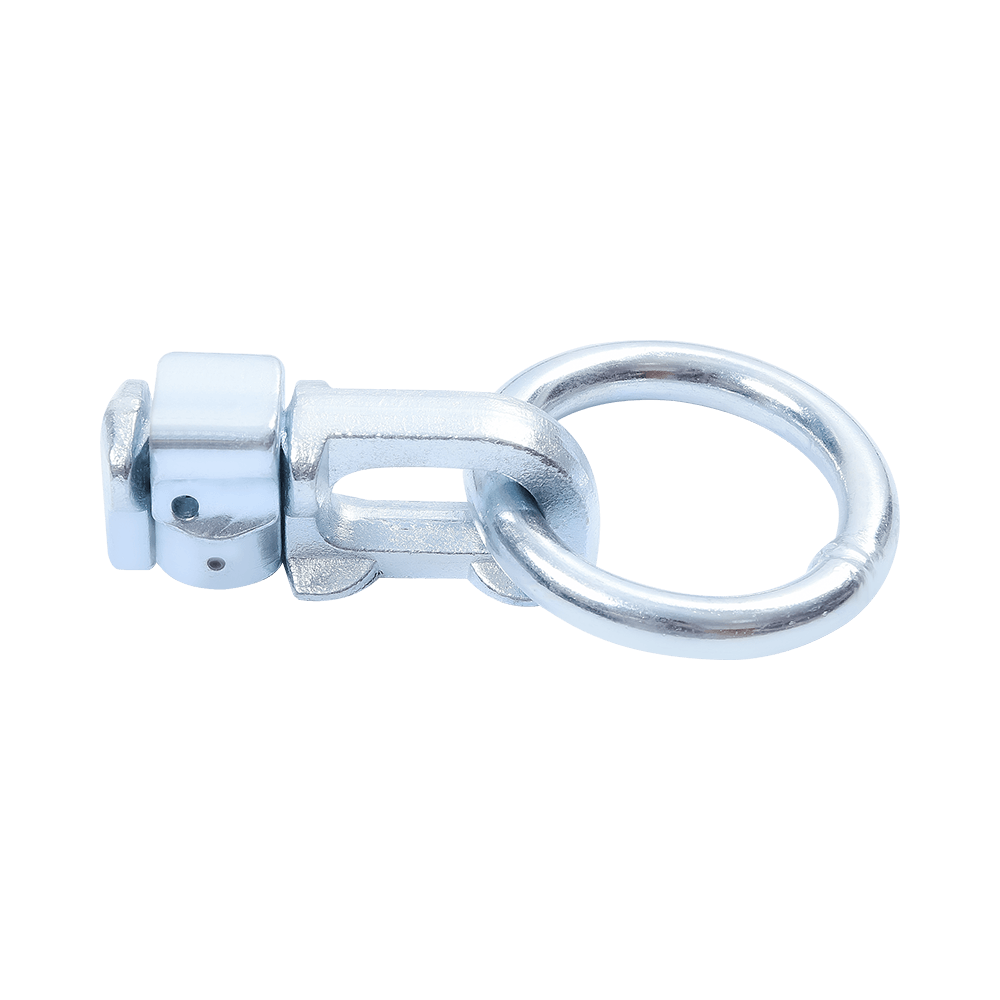
Accepts two straps from a single E track slot — useful when you need two separate tie-down points from one rail position, such as securing both the front and rear of a motorcycle wheel chock, or anchoring two adjacent pallet straps without consuming extra rail slots.
A round welded ring that snaps into the E track slot. Used for attaching rope, bungee cords, or chain hook ends. Particularly useful when securing irregular or lightweight loads where ratchet straps would apply too much compression force.
Designed to accept horizontal aluminum shoring beams (load bars) that span the trailer width. These beams divide the cargo area into vertical sections, preventing loads from shifting laterally. Common in dry-van trucking and larger enclosed cargo trailers where full load containment is needed without straps crossing the cargo.
An integrated reel-and-strap unit that mounts permanently in the E track slot. The strap retracts when not in use, keeping the trailer interior clear. Available in working load capacities from 500 lbs to 3,300 lbs depending on strap width (1-inch, 1.5-inch, or 2-inch webbing).
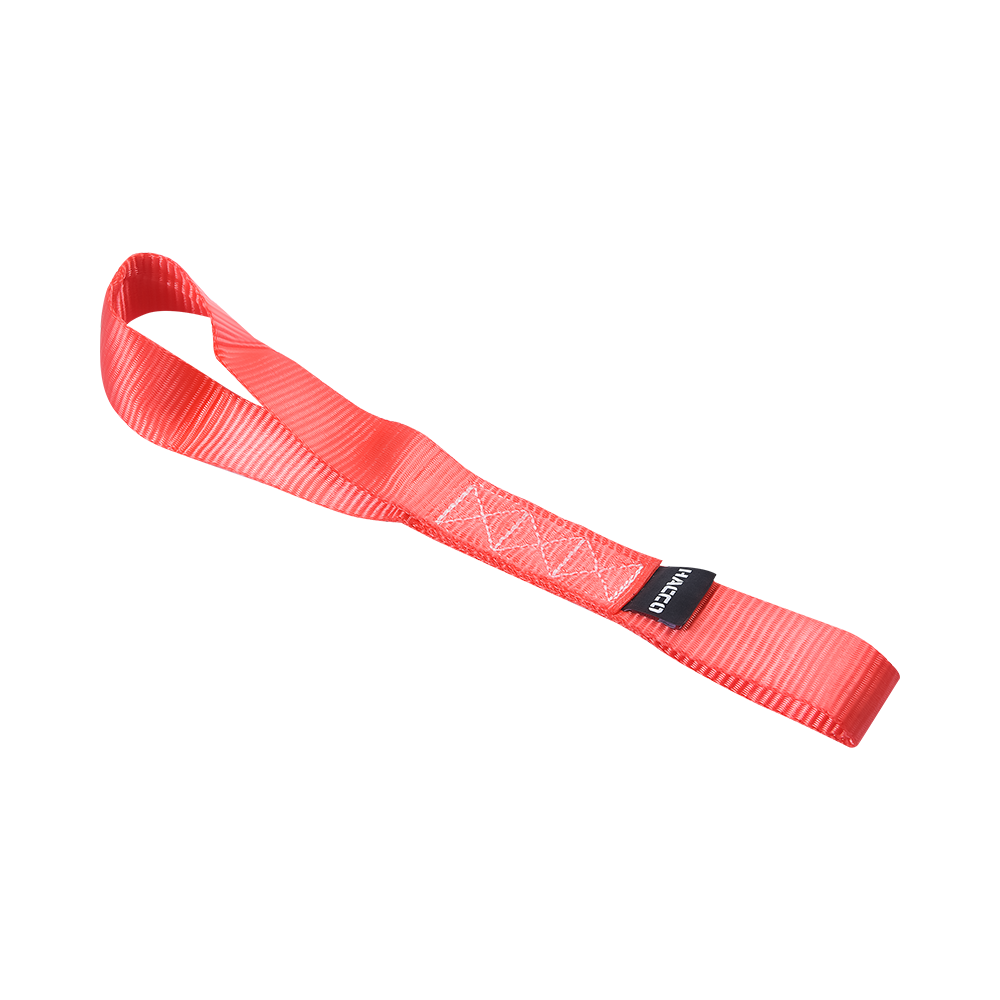
Cargo trailer E track straps are not interchangeable with generic tie-down straps. They are purpose-built with spring-loaded end fittings engineered to the E track slot profile. Key selection criteria:
E track straps are available in 1-inch, 2-inch, and 4-inch webbing widths. Wider straps distribute load force across a larger contact area, reducing damage to cargo surfaces and providing higher working load limits:
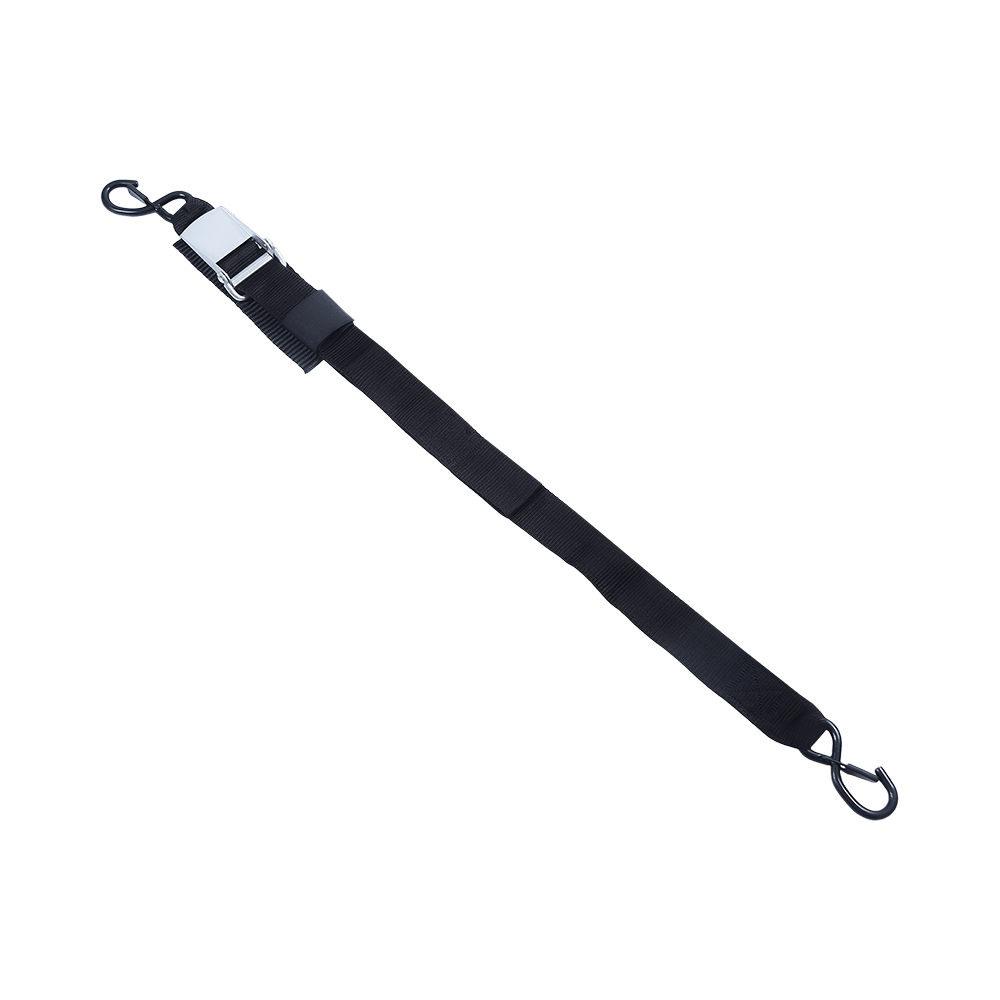
Ratchet straps use a gear-and-pawl mechanism to apply and maintain high clamping tension — best for heavy, dense loads that could shift under braking force. Cam buckle straps use a friction-grip cam to secure lighter loads without over-tightening, making them suitable for soft goods, furniture, or fragile items where excessive compression could cause damage.
Standard cargo trailer E track straps range from 6 ft to 20 ft in length. For cross-trailer tie-downs on a standard 7-ft-wide enclosed trailer, a 10–12 ft strap provides enough working length. Floor-to-ceiling vertical tie-downs on a 6.5-ft interior height trailer typically require an 8–10 ft strap.
| Component Type | Best Use Case | Typical WLL | Key Advantage |
|---|---|---|---|
| 2" Ratchet E Track Strap | ATVs, furniture, general cargo | 3,333 lbs | High tension, reliable hold |
| 2" Cam Buckle E Track Strap | Soft goods, fragile items | 1,000 lbs | No over-tightening risk |
| Single E Track Fitting | Universal direct tie-down | 1,500 lbs | Maximum versatility |
| Shoring Beam End Fitting | Lateral load containment | Up to 5,000 lbs (beam-rated) | Strap-free cargo division |
| Retractable Strap Fitting | Frequent-use applications | 500–3,300 lbs | Auto-retracts, clutter-free |
When selecting heavy duty E track for trailer installations, the rail material is a primary decision that affects load capacity, weight, and longevity:
Steel rails — typically 12-gauge cold-rolled steel with a zinc or powder-coat finish — are the standard choice for heavy duty E track for trailer setups. A single 5-ft steel E track rail typically carries a working load limit of 5,000–10,000 lbs distributed across its length, depending on mounting and gauge. Steel is preferred when maximum load capacity is the priority, such as in equipment hauling, vehicle transport, or commercial freight applications.
Aluminum E track weighs approximately 40–50% less than equivalent steel rails, which matters significantly on long runs where trailer weight directly affects fuel consumption and payload capacity. Aluminum is naturally corrosion-resistant — ideal for trailers hauling marine equipment, landscaping materials, or cargo exposed to moisture. The trade-off is a lower working load limit, typically 30–40% less than comparable steel rails.
For most enclosed cargo trailers hauling vehicles, equipment, or mixed freight exceeding 2,000 lbs per tie-down point: steel is the correct choice. For lightweight enclosed trailers — cargo vans, horse trailers, or trailers where corrosion resistance outweighs raw load capacity — aluminum is the practical option.
Figure 1: Approximate distributed working load limits by E track rail material and gauge (5-ft section, properly bolted)
A proper trailer E track installation kit contains more than just the rails. Understanding every component ensures a structurally sound installation that achieves the rated load capacity:
A standard trailer E track installation kit for a 16-ft enclosed cargo trailer with full wall coverage on both sides typically includes six to eight 5-ft rail sections, 24–32 bolts with backing hardware, 8–12 strap end fittings, and 4–6 ratchet straps. Floor-mounted track adds additional rails and hardware.
Incorrect installation is the leading cause of E track failure under load. Follow this sequence for a structurally sound setup:
| Mounting Location | Recommended Height / Position | Best Cargo Application |
|---|---|---|
| Wall — lower rail | 16–24 in. from floor | Motorcycles, ATVs, pallets |
| Wall — upper rail | 48–60 in. from floor | Stacked cargo, equipment |
| Floor — center run | Centered longitudinally | Wheel chocks, vehicle tie-down |
| Floor — side runs | 6–12 in. from each wall | Furniture, appliances, crates |
| Ceiling | Along roof purlins | Overhead strap routing, bikes |
Even a perfectly installed E track system for cargo trailer use cannot compensate for incorrect strap technique. These rules apply to every haul:
Understanding where E track outperforms alternatives helps justify the investment in a complete trailer E track installation kit:
For enclosed cargo trailers handling varied loads across multiple hauls, the E track system for cargo trailer use consistently offers the best combination of flexibility, rated capacity, and installation simplicity.



The company specialises in the field of logistics transportation,cargo control,lifting and hoisting products.


joe@forcerigging.com
+86-18650363763
No.469, Liansheng Road, Yinzhou District, Ningbo, Zhejiang Province, China.315111
Copyright © 2025 by Ningbo Force Auto Parts Co., Ltd. All Rights Reserved. China Ratchet Straps Manufacturers OEM/ODM Load Binding and Rigging Company


 English
 Español
 عربى
عربى 中文简体
中文简体